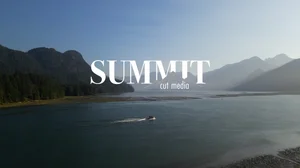
Concrete depreciates. Sovereignty appreciates.
For decades, the corporate and resource sectors have viewed environmental restoration through a fundamentally flawed lens: as a philanthropic PR exercise or a necessary "cost center" to balance the books. Today, the financial sector has quietly rewritten those rules. The deployment of Indigenous stewardship is no longer a conservation effort; it is the ultimate capital asset.
The Problem: Your "Pretty" Video is Invisible
Most environmental communications look like charity campaigns. A sweeping drone shot of a forest, a slow-motion clip of a river, soft acoustic music. To a leisure traveler or a donor, this looks nice. But to an institutional investor or a government infrastructure fund looking for yield and resilience, it looks like a sunk cost. It lacks financial gravity.
When atmospheric rivers recently hit British Columbia, the limits of the old model were exposed. Standard grey infrastructure—concrete dikes and retaining walls—failed. The market learned that fighting the physics of a territory is a losing investment. Protecting a watershed is no longer a "nice-to-have" conservation project; it is the deployment of high-yield bio-infrastructure.
The 2026 Creative Mindset: From "Conservation" to "Capital Asset"
The financial anchors of the Canadian economy are already making this pivot. RBC’s Climate Action Institute recently released a framework explicitly defining nature not as a cost, but as an "investable asset class" critical to pro-growth GDP agendas.
Backing this up, Nature United provides the execution data proving that the ROI on Natural Climate Solutions (NCS) drastically outperforms traditional grey infrastructure.
Your market signal needs to reflect this sophisticated reality. Summit Cut Media helps IEDCs and legacy brands pivot from simply "capturing nature" to "crafting the investment thesis." If you want the market to value your stewardship, you must start with a narrative that speaks to capital.
3 Pillars of Communicating Bio-Infrastructure
If you want your natural assets to be valued correctly by the world's best financial partners, here is the blueprint we apply to our strategic video production:
1. Sell "Yield," Not Just "Greenery"
Instead of just panning over a restored wetland, the narrative must focus on the function of that space as a working asset.
The Lesson: An investor needs to see the utility, not just the beauty. If RBC calls it an investable asset class, your visuals must reflect that weight.
The Summit Cut Approach: We don't just film the river. We film the operational reality of the watershed as infrastructure. We visualize the scale and the biological engineering that makes it a superior alternative to concrete.
2. Sell "Resilience," Not Just "Restoration"
Grey infrastructure fails when pushed past its design limits; bio-infrastructure adapts.
The Lesson: The market is desperate for climate resilience to protect their supply chains and investments.
The Summit Cut Approach: We stop filming generic "nature walks." We focus on the deliberate, engineered stewardship behind the natural solution, proving that your territory is actively mitigating risk.
3. Sell "Sovereignty," Not Just "Charity"
A biological asset is only as strong as the governance protecting it.
The Lesson: Indigenous stewardship is the framework that guarantees the longevity of the bio-infrastructure.
The Summit Cut Approach: We make the governance cinematic. By capturing the generational knowledge and sovereign management of the land, we provide cinematic proof of the asset’s provenance and security.
Don't let your sovereign natural assets be reduced to a scenic backdrop. Let’s craft a narrative that proves your authority, secures capital investment, and establishes your legacy.